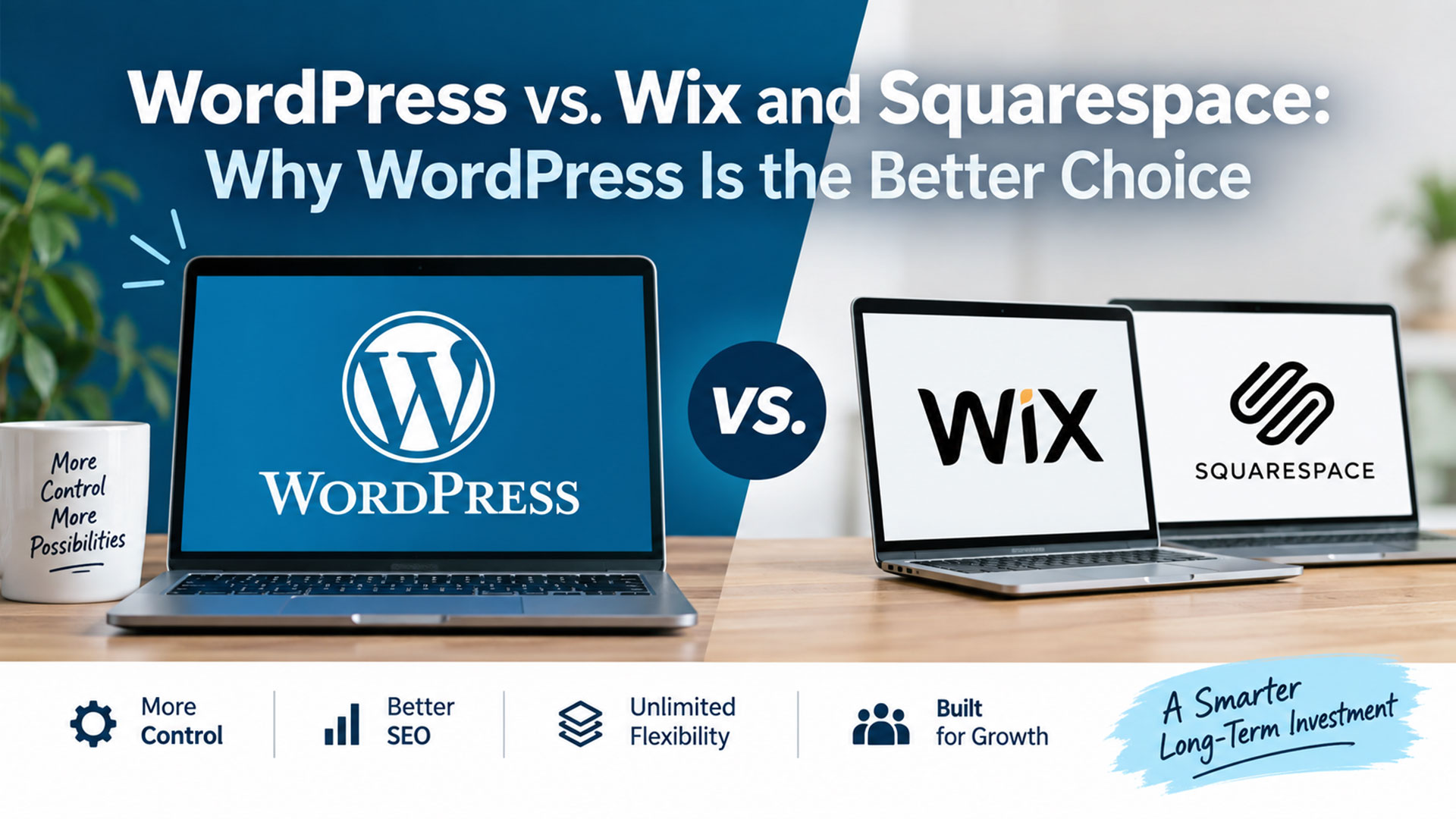
WordPress vs. Wix and Squarespace: Why WordPress Is the Better Choice
If you’re building a new website, you’ve probably encountered platforms like Wix and Squarespace. They’re heavily marketed as easy ways to get a website online quickly.
So why does Information Experts recommend WordPress instead?
Because a business website shouldn’t be built around what is easiest today. It should be built on a platform that gives you the flexibility, ownership, control, and scalability you’ll need tomorrow.
For us, that platform is WordPress.
What’s the Biggest Difference Between WordPress, Wix, and Squarespace?
The biggest difference is control.
Wix and Squarespace are proprietary website-building platforms. Your website operates within the hosting, functionality, tools, and limitations their platforms provide.
WordPress is an open-source content management system that can be installed with different hosting providers and extended through themes, plugins, APIs, integrations, and custom development.
That difference becomes increasingly important as your organization grows.
WordPress Gives Your Website Room to Grow
Your website today may only need ten pages and a contact form.
Tomorrow, you may want online payments, event registration, a client portal, membership functionality, advanced forms, CRM integrations, marketing automation, e-commerce, custom databases, or functionality you haven’t even considered yet.
With Wix or Squarespace, the question often becomes:
“Does the platform support this?”
With WordPress, the question is:
“What’s the best way to build this?”
That’s a fundamental difference.
You Have More Control Over Your Website
When your website is an important business asset, control matters.
WordPress gives organizations significantly more control over hosting, website files, databases, code, integrations, backups, security tools, and development.
You can change hosting companies. Change developers. Redesign the website. Add functionality. Integrate new technology.
You’re not building your digital presence entirely inside one company’s proprietary ecosystem.
Your website should adapt to your business, not the other way around.
Moving Your Website Is Easier
One of the most overlooked questions when choosing a website platform is:
What happens if we eventually want to leave?
Closed website builders can make moving to another platform more complicated because portions of the website may need to be rebuilt.
WordPress websites are portable between compatible hosting environments. Moving a WordPress website from one hosting provider to another is a normal part of managing the platform.
That gives your organization more control over an asset you’ve invested significant time and money into building.
WordPress Offers Greater Design Flexibility
Templates make platforms like Wix and Squarespace easy to start with.
But your website shouldn’t look or function a certain way simply because that’s what your website builder makes easy.
WordPress can support everything from a straightforward business website to a completely custom digital experience.
As your brand evolves, your website can evolve with it without requiring you to abandon the underlying platform.
Your brand should determine your website design. Your website platform shouldn’t determine your brand.
WordPress Is Built for Integrations
Modern websites don’t operate independently.
They connect with CRMs, email marketing platforms, analytics tools, payment processors, scheduling systems, automation platforms, membership systems, learning platforms, social media, AI tools, and other business applications.
WordPress’s enormous ecosystem of plugins, APIs, integrations, and development tools allows your website to become part of a much larger technology stack.
This becomes even more important as organizations use automation and AI to connect systems and eliminate repetitive work.
Your website shouldn’t be an island. It should be connected to your business.
WordPress Gives You More SEO Control
A website platform doesn’t automatically give you better Google rankings.
But your platform determines how much control you have over the factors that influence search performance.
WordPress provides extensive control over URL structures, redirects, metadata, structured data, internal linking, sitemaps, performance optimization, image optimization, caching, schema, content architecture, and specialized SEO tools.
That’s especially valuable as an SEO strategy becomes more sophisticated.
The advantage isn’t that WordPress magically “does SEO.”
The advantage is that WordPress gives you the freedom to build the SEO strategy your organization needs.
WordPress Is Better Positioned for AEO and GEO
Search is no longer limited to traditional Google results.
People increasingly discover organizations through AI Overviews, answer engines, ChatGPT, Gemini, Perplexity, Copilot, and other AI-powered experiences.
That means websites need to support Search Engine Optimization, Answer Engine Optimization, and Generative Engine Optimization.
These strategies rely on clear content architecture, authoritative information, structured data, technical accessibility, and the ability to adapt as search technology changes.
No website platform can guarantee that an AI system will cite your organization.
But WordPress provides something increasingly valuable:
The flexibility to adapt.
As search evolves, your website can evolve with it.
WordPress Can Become More Than a Website
This may be WordPress’s biggest long-term advantage.
A business website may begin as a marketing tool, but eventually become part of a much larger digital ecosystem.
WordPress can support:
- Client portals
- Membership areas
- Directories
- Learning systems
- Event registration
- E-commerce
- Advanced lead-generation systems
- CRM integrations
- Automated workflows
- Custom applications
- AI-powered tools
You may not need these capabilities today.
Choosing WordPress means you don’t have to choose a new website platform when you need them tomorrow.
The Bottom Line
Wix and Squarespace are website builders.
WordPress is a platform you can build a business around.
That’s why Information Experts recommends WordPress.
It provides greater control over your website, greater flexibility in design and development, deeper integration opportunities, stronger options for sophisticated SEO strategies, more portability, and significantly more room to grow.
Your website is too important to build around the limitations of a proprietary website builder.
It should be able to evolve alongside your marketing, sales, technology, search strategy, and business operations.
We don’t recommend WordPress because it’s the easiest way to build a website. We recommend WordPress because we believe it’s the best foundation for building one that lasts.
Build Your Website on the Right Foundation
Information Experts designs, develops, maintains, and optimizes WordPress websites built around your organization’s goals and designed to evolve with your business.
Whether you’re building something new or ready to move beyond Wix or Squarespace, contact us to start the conversation.